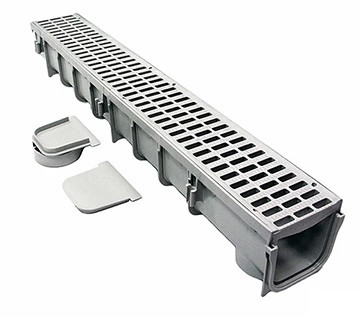
Trench Drain with Curves
DRAINAGE PROBLEM: CLOGGED SUBSURFACE PIPES
Drainage system maintenance requires the regular removal of debris which can block pipes and stop or reduce flow. Leaves and debris are collected in gutters along with rainwater and make their way through the downspout and into pipe lines. The result can be a clogged line that can cause water backup and costly damage to basements, foundations and the landscape. Clearing pipe clogs can be done using a high pressure water tool or a snake- but snakes are not recommended for single wall pipe with a corrugated interior. Cleaning pipe lines is a hassle which can easily be prevented. Here is one option:
DRAINAGE SOLUTION: FLEX GRATE Landscape Drainage Filter

- Filters leaves and debris
- Eliminates emptying catch basins
- Built-in connector for easy installation
- Protects against clogged pipes
- Easily bends and holds its shape
- Expands 14 inches
- Fits 2″ x 3″ or 3″ x 4″ downspouts
InvisaFlow uses recycled HDPE from post consumer bottles in their products and 100% RECYCLED paper in their packaging.
DRAINAGE PROBLEM: How to re-direct rainwater from structures without digging a pipeline?
Now you can reroute rainwater while blending the drainage system in with the landscape. Grading is important, but it’s not always enough to protect the foundation of a home. Every downspout should have an extension installed to direct the runoff a safe distance from the foundation.
DRAINAGE SOLUTION: Stealth Flow Low Profile Downspout Extension
The StealthFlow low-profile downspout extension gets the job done and REQUIRES NO DIGGING. Simply cover the StealthFlow extension with mulch, stones or straw.

- Diverts water away from the foundation
- Disappears into the landscape
- No digging required
- Fits all standard downspouts
- Snap together 28” interlocking sections to any desired length
DRAINAGE PROBLEM: HOW TO TAKE AWAY RAINWATER WITHOUT TAKING AWAY FROM THE LANDSCAPE?
DRAINAGE SOLUTION: STEALTH SPOUT LOW-PROFILE DRAIN EMITTER
The low profile design of the StealthSpout Drain Emitter makes the drainage system in your landscape virtually blend in with its surroundings. The drain exit disappears into the landscape, leaving its beauty unobstructed. The StealthSpout simply connects to the end of 4” drainage pipe and its low profile spout gives wider water dispersion, reducing erosion. Constructed of high density polyethylene, the StealthSpout fits 3” and 4” straight pipe and 4” corrugated pipe.

StealthSpout is perfect for low grade applications like curbs, where round pipe installation prevents correct forming. The thin layer of concrete can crack over time.
The low profile design of StealthSpout allows for a greater amount of concrete around the outlet- and a more desirable long term result.
12” extensions are available to complete extended drainage runs. The interlocking pieces snap together on the end of the StealthSpout and can be used under sidewalks, in retaining wall weepholes, curbs, and planting beds.

Dewatering Bags
DRAINAGE PROBLEM: HOW TO RETAIN SEDIMENT IN WATER PUMPING APPLICATIONS?
DRAINAGE SOLUTION: USE A DEWATERING BAG- NOW WITH REUSEABLE OPTIONS.
Dewatering Bags help maintain ground water quality, decrease pollutants, and safely manage flooding as regulated through the National Pollution Discharge Elimination System (NPDES), Phase I & II. When the pumped water reaches the device, the sediment is captured by the bag. Fabric coverage provides steady filtration and a high flow rate while retaining soil particles. Dewatering Bags offer an economical solution for many stormwater situations.

- EASILY ATTACHES TO DISCHARGE HOSE
- MORE CONVENIENT TO USE THAN SEDIMENT TRAPS OR OTHER MECHANISMS
- AVAILABLE IN 6’ x 6’, 10’ x 10’, 10’ x 15’, AND 15’ x 15’ SIZES.
Ultra-Dewatering Bag, Reusable Model
Reusable Dewatering Bag for Large Jobs and Big Savings
This Dewatering Bag can be used to capture sediment suspended in water pumped from low-lying areas or retention ponds. It is ideal for use in dewatering operations with large quantities of silt, sediment, or dirt. The Ultra-Dewatering Bag can be emptied and reused repeatedly.

- Large 3’–5’ opening allows easy access and removal of trapped sediment.
- Galvanized steel Locking Rods are quickly and easily installed to secure bag opening during dewatering.
- Helps comply with NPDES, 40 CFR 122.26 (1999).
- Available in 3’ x 5’ or 5’ x 7’ sizes.
Wattles, Socks, and Logs
Best Management Practices
“It is not practical to assume that all erosion and sedimentation issues associated
with a construction project can be controlled through surface stabilization.
Construction, by nature, involves land disturbance and as such will result in soil
material being left unprotected as clearing and grading operations occur.
Therefore, sediment control must be an integral part of any erosion and sediment
control plan.” -From the Indiana Department of Environmental Management’s Storm Water Pollution Prevention Plan.
Wattles, Socks and Logs
The Straw Wattle is a lightweight option for sediment control. The straw wattle consists of 99.9% weed-free wheat, oat, barley, or rice straw, compacted into a 9” diameter. Wattle netting is made of non-woven photodegradable HDPE (high density polypropylene) with a 1 year UV inhibitor.

Installed following contours intermittently throughout the slope to decrease water velocity and increase sediment retention, the Straw Wattle can also be beneficial around water inlets and catch basins or topsoil stockpiles. Straw Wattles can be used in conjunction with other erosion control techniques including, but not limited to, erosion control blankets, silt fence, hydro-seeding and loose straw.
The 10’ Sediment Sock (pictured below) can be filled on site. It is a tube of 36” needle punched, 6 ounce nonwoven black fabric, machine produced from 100% polypropylene. The sock is specifically designed to hold on to sediment while readily allowing water to pass thorough.
The 10’ Sediment Log is constructed with black 6 ounce non woven filter fabric and is pre-filled with mulch or wood chips. It retains sediment yet is highly permeable to water. Characteristics include small pore size, high U.V. resistance, high permittivity and a high percent open area.

Best Management Practices
“Erosion control is the first line of defense in protecting water quality at a
construction site. Reducing erosion at the source is much more effective and
efficient than trying to trap suspended sediment in surface water runoff. Erosion
control is achieved by protecting the soil surface from raindrop impact and
overland flow of storm water runoff.”
-From the Indiana Department of Environmental Management’s Storm Water Pollution Prevention Plan.
This begins our e-news focus on the many options available for erosion and sediment control when formulating your Storm Water Pollution Prevention Plan (SWPPP). The series will be called: Best Management Practices and it will offer information both within this issue and in issues to come.
Part One
Vegetative controls are the most cost effective method of soil surface protection – and are certainly more aesthetically pleasing than hard armor systems such as rip rap or gabions. One way to achieve vegetative control is to use Erosion Control Blankets
Erosion Control Blankets provide either temporary or permanent surface stabilization, creating a secure environment where seed can be established and vegetation can take root. Erosion Control Blankets are composed of mulch that is in a netting material. Contents range from natural fibers such as straw, wood and coconut to synthetic fibers. There are many types available and each has its own intentions and purposes for use. Erosion Control Blankets must be secured to the soil in order to reduce potential for movement from the intended site.
BEFORE
AND AFTER!
For more information on the types of Erosion Control Blankets available, click here:
DRAINAGE PROBLEM: HOW TO PROTECT AGAINST ROOT DAMAGE?
Drainage Solution:
The Biobarrier® System was originally created in response to the U.S. Department of Energy’s need for a product that could be used in the closure cap of hazardous waste sites. The Goal: an invention that could prevent root intrusion and any possible chance that hazardous waste could get into the food chain. The Result: The Biobarrier® System; a unique method of root and weed control. The Biobarrier® System manages roots through the slow, controlled release of trifluralin, a root inhibition herbicide that has been in use on food crops in the United States for more than 35 years.
When Biobarrier is used for root control, tree roots reaching the zone
of trifluralin are redirected, while roots outside the zone continue to grow
naturally. When Biobarrier is used for weed control, the root systems of
weeds do not grow in the trifluralin zone next to the fabric; roots of trees
and shrubs in the same area are below the zone and are not affected.
A pattern of 7/16-inch hemisphere nodules injection molded to Typar® geotextile fabric on 1.5-inch centers creates a continuous zone of root control protection. The Biobarrier® System does not harm vegetation: it works by creating a vapor zone where roots will not grow. Trees concentrate growth in branch roots away from the trifluralin zone and any roots reaching the zone begin to grow away from it.
Because it is a geotextile, the Biobarrier System is water permeable and does not disturb soil hydrology and is flexible enough to be contoured to follow the ground’s shape.
Biobarrier® Root Control Fabric
A survey of California cities taken nearly 10 years ago showed that more than $70 million was spent annually on root-infrastructure conflicts. Sidewalk repair alone cost $23 million and some $9 million was spent on legal claims. Tests have proven that root barriers cause roots to grow lower than the 18 to 24 inches in which they prefer to grow, which helps protect hardscapes from damage.
The Biobarrier® System is a geotextile which redirects roots due to the slow, controlled release of trifluralin. Trifluralin is released in vapor form, creating a root inhibition zone in the soil. Roots penetrate the zone until root tips reach the herbicidal concentration that prevents that species’ root tip cell division. Only the root tip cell’s ability to divide and grow is affected; neither the plant nor its roots are killed because trifluralin does not spread throughout the plant.
Install Biobarrier® Root Control Fabric vertically to inhibit tree and shrub root growth into:
- Building Foundations
- Golf Courses
- Green roofs
- Irrigation systems
- Landscaped areas
- Levees and dams
- Parking lots
- Retaining Walls
- Septic Tanks/Fields
- Sidewalks
- Swimming Pools
- Tennis Courts
- Underground Pipes/Cables and Storage Tanks
- Utility Substations
Biobarrier® Root Control Fabric eliminates root damage for 15 years…it’s guaranteed.
The results of Biobarrier® Root Control Fabric used on a retaining wall.
Roots are visibly growing away from the area where the fabric was placed.
Glue: How To!
The glued joint connection between pipe and fittings is the last crucial link in a plastic pipe installation and can bring about the success or failure of the system as a whole. Therefore, it requires the same professional care and attention that is given to other parts of the system. There are recommended techniques for making high strength joints when solvent cementing plastic pipe and fittings in a variety of conditions. The basic principles for solvent cementing small diameter plastic pipe can be found in this video provided by
SOLUTIONS FOR SPORTS FIELD CONSTRUCTION
Excavating traditional pipe and gravel filled trenches is costly, time consuming and disruptive to playing surfaces. An easier and more economical solution for a well-drained field is J-DRain MVP for Maximum Velocity & Performance. This J-DRain prefabricated drainage system (PDS) consists of two parts:
1) A Geosynthetic Fabric with outstanding water flow levels. The fabric is attached to the core and acts as a filter, holding back soil and backfill, yet allowing water to enter the drainage core quickly.
2) A Molded Plastic Core constructed of high density polyethylene. The 3-dimensional dimpled or “honeycombed” core has high compressive strength and is resistant to chemicals and the elements. It provides tremendous in-plane water flow levels and better drainage than the old pipe and stone methods. These products are often described as “sheet drains” or “strip drains.”
PICTURED: J-DRain MVP
On NATURAL TURF FIELDS, J-DRain MVP is typically placed vertically in narrow trenches and sloped to discharge to the sideline trench.
- Requires only shallow, narrow trenches
- Has a high flow capacity
- Is easy to handle and install
- Needs no gravel backfill
- Is very effective- no clogging
PICTURED: J-DRain MVP-6 IN TRENCH WITH SAND BACKFILL ON NATURAL TURF FIELD
PICTURED: J-DRain MVP-6 PLACED IN TRENCH ON NATURAL TURF FIELD
On SYNTHETIC TURF FIELDS, J-Drain MVP is typically placed horizontally across the playing field and is sloped to sideline trenches. This installation method eliminates cross-field trenching.
- Very high flow rate
- Easy to install
- High compression strength due to its HDPE core
- Large collection area
- Greatly reduced amount of gravel backfill (compared with traditional pipe filled trenches)
Pictured: J-DRain MVP: HORIZONTAL APPLICATION ON SYNTHETIC TURF FIELD
J- DRain MVP has been used by Drainage Solutions, Inc. customers to create a well drained playing surface for:
Old Dominion University…
AND MANY OTHERS, including:
The Baltimore Ravens
Appalachian State University (NC)
Charlottesville High School (VA)
Duke University (NC)
FC Hammond Middle School (VA)
Saint Patrick’s Episcopal School (DC)
Sportsquest- Synthetic Turf Drainage Base- 17 fields (VA)
Hampton Roads Soccer Association (VA)
Coppin State University (MD)
KOI POND NEEDS A SHUTOFF?
Solution: VALTERRA KOI POND KNIFE GATE VALVE
Valterra specializes in economical knife gate valves which are ideal for drain applications. Use the Valterra PVC Koi Pond, Pool & Spa Valve as a quick shut-off in low pressure or vacuum lines. This valve offers quick opening and closing via a sliding gate and is easily disassembled for inline servicing.
Valve Specifications:
- Full port opening
- Fits PVC Schedule 40 pipe
- Socket x Socket
- Push / pull operation
- Max working temperature: 167 degrees
- Sizes available: 1 ½”, 2”, 3”, 4”, 6”, 8”, 10” and 12”
DRAINAGE SYSTEM SOLUTIONS
Research indicates that a well maintained landscape can increase the value of a home by as much as 15%. Considering the potentially destructive effect that water has on buildings and the surrounding terrain, every landscape needs a proper drainage system. A drainage system has three major phases: collection, conduction and discharge. This video from NDS shows how to correctly redirect water away from structures. (Insert NDS Logo)